
句法層次的進階文法:名詞化、平行與標點的隱形地雷
文法都「對」了卻仍被批 awkward?學術英文真正的關卡在句子如何被組裝——名詞化的拿捏、複雜主謂一致、修飾語掛靠、平行結構與標點精準。
當文法「正確」卻仍被退稿:句法層次的隱形地雷
入門篇談過時態、被動與冠詞——那是單字與短語層級(word-level)的三大地雷。但你或許遇過這樣的困境:把每個動詞時態都查對了、冠詞都補齊了,審稿人卻仍在 margin 寫下「awkward」、「unclear」、「please revise」。問題往往不在「對不對」,而在「合不合學術句法的節奏」。
學術英文真正的進階關卡,是句子如何被組裝(syntax):名詞化(nominalization)的拿捏、複雜主詞與動詞的一致、修飾語的掛靠、平行結構(parallelism),以及那些看似瑣碎卻決定可讀性的標點。這篇我們直接跳過基礎,進入句法層次——這也是母語審稿人「說不出哪裡錯,但就是覺得不順」的真正來源。
名詞化:學術風格的雙面刃
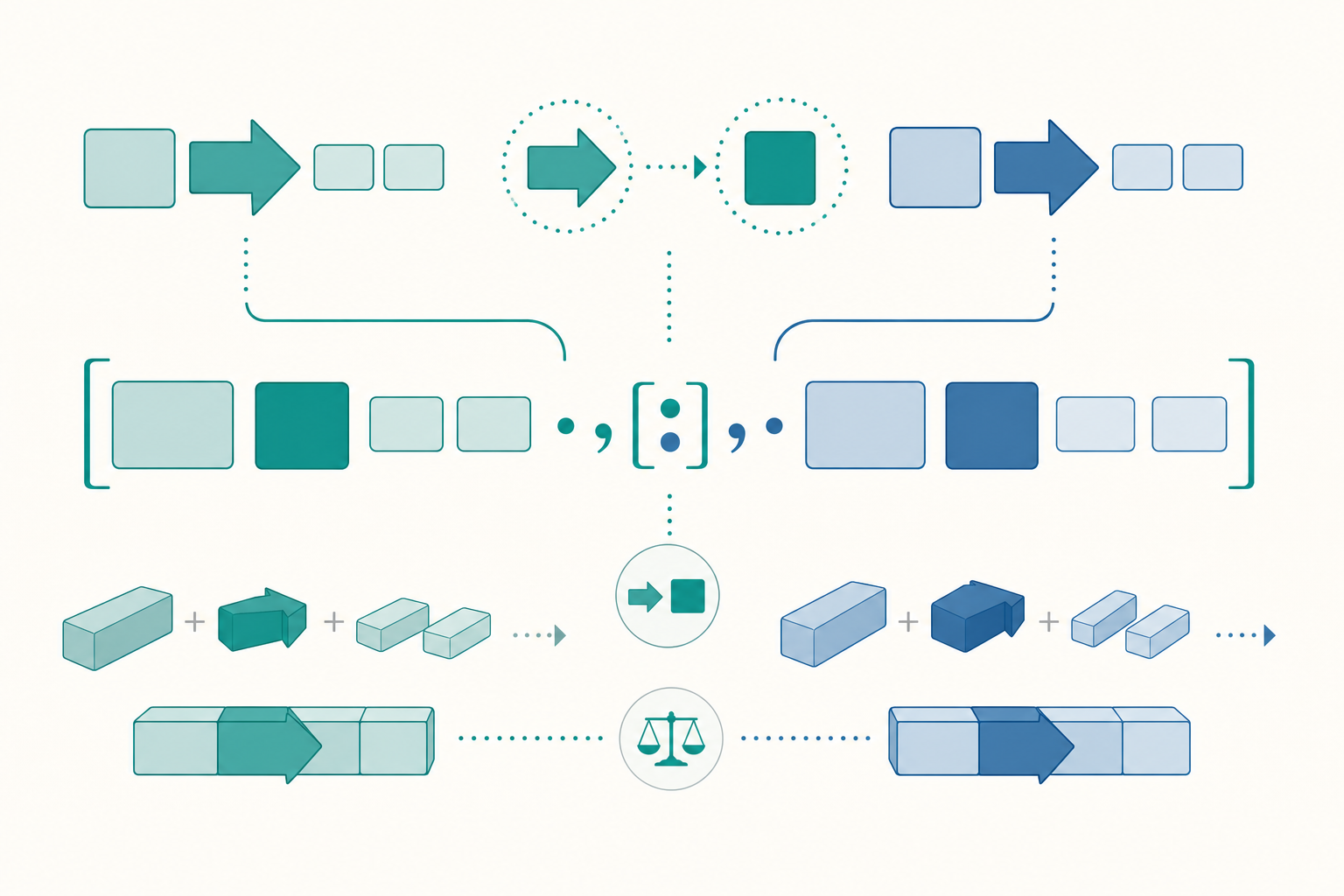
名詞化(nominalization)指把動詞或形容詞轉成名詞:analyze → analysis、decide → decision、able → ability。學術寫作偏愛名詞化,因為它能把「過程」打包成「概念」,讓句子聚焦於抽象實體而非具體動作者。系統功能語言學(Systemic Functional Linguistics)的 Halliday 稱此為文法隱喻(grammatical metaphor):把本該是「事件」的東西,重新編碼為「事物」。
適度名詞化讓你能對概念下評論、做比較、追蹤前後文:
- 不佳(口語、難以承接):
We measured how the temperature changed, and this was important.("this" 指什麼?changed?measuring?) - 改良(名詞化使指涉清晰):
The measurement of temperature change was central to our analysis.
名詞化也是舊資訊→新資訊銜接的關鍵。前句的動詞,可在下一句化為名詞當主詞,形成「主題推進」:
The catalyst degraded rapidly. **This degradation** reduced yield by 40%.
但名詞化是雙面刃。過度堆疊會製造所謂的「殭屍名詞(zombie nouns)」——一連串抽象名詞吞掉了真正的動詞,句子變得臃腫、動作消失、責任歸屬模糊:
- 不佳(殭屍名詞群):
The **implementation** of the **reduction** of the **utilization** of resources was an **expectation** of the committee. - 改良(還原動詞):
The committee **expected** us to **reduce** how many resources we **used**.
判斷準則很簡單:問自己「真正的動作是什麼?誰在做?」 如果主句的動詞變成了 be、occur、take place、is an indication of 這類空殼動詞,而真正的動作躲在後面的名詞裡,就該還原。
看一個例子
下面是一段方法描述的不同寫法,觀察名詞化密度如何影響可讀性:
- 過度名詞化:
The **determination** of the **effectiveness** of the **intervention** required the **administration** of a **questionnaire**.(5 個抽象名詞,0 個有意義動詞) - 還原動作:
To **determine** whether the intervention **worked**, we **administered** a questionnaire.(3 個動詞各自承載一個動作) - 學術但平衡:
We **assessed** intervention **effectiveness** using a questionnaire.(保留 1 個有用名詞 effectiveness,動詞 assessed 扛起主要動作)
第三種才是目標:不是消滅名詞化,而是讓每個主句保有一個真正的動詞,名詞化用於需要被指涉、比較或評論的概念。
複雜主詞與主謂一致:被介系詞片語騙過去
主謂一致(subject–verb agreement)在簡單句裡很直觀,但學術句子的主詞常被一長串修飾語撐開,真正的中心名詞(head noun)離動詞很遠,於是常與最靠近的名詞「假性一致」。
- 不佳:
The **distribution** of scores across all three conditions **were** non-normal.(動詞被 conditions 帶歪了) - 改良:
The **distribution** of scores across all three conditions **was** non-normal.(中心名詞是 distribution,單數)
幾個高頻陷阱:
The number ofvsA number of:The number of participants **was** 120.(the number = 單一數字,單數);A number of participants **were** excluded.(a number of = 許多,複數)。Each / every / either / neither帶頭:一律單數。Each of the samples **was** tested.,不是 were。- 拉丁字尾的複數:
data是datum的複數、criteria是criterion的複數、phenomena是phenomenon的複數。嚴謹期刊仍要求The data **are** consistent.(不過部分領域已接受 data 作不可數單數,投稿前查目標期刊的 style guide)。 As well as / along with / together with:這些不是and,不會把單數主詞變複數。The control group, as well as the two treatment groups, **was** monitored.
判斷法:先在心裡刪掉主詞後面所有介系詞片語與插入語,只留中心名詞,再決定動詞單複數。
修飾語的掛靠:懸垂與錯置
懸垂修飾語(dangling modifier)是句首的分詞片語找不到合理的邏輯主詞——而學術寫作裡這特別常見,因為作者習慣用 -ing 開頭描述方法或推論。
- 不佳(懸垂):
Using a two-way ANOVA, the differences were significant.(誰在 use ANOVA?句子的主詞是 differences,難道是「差異」在跑統計?) - 改良 A(補回主詞):
Using a two-way ANOVA, we found the differences to be significant. - 改良 B(改成完整子句):
A two-way ANOVA showed that the differences were significant.
同類錯誤也出現在 Based on 與 Compared to/with:
- 不佳:
Based on these results, further research is recommended.(results 不是「base」這個動作的執行者) - 改良:
On the basis of these results, we recommend further research.或These results suggest that further research is needed.
錯置修飾語(misplaced modifier)則是把限定詞放錯位置,尤其是 only:
We only measured temperature at noon.(我們「只是測量」,沒做別的?)We measured temperature only at noon.(我們只在中午測——這通常才是本意)
原則:修飾語要緊貼它修飾的對象;句首的分詞片語,其邏輯主詞必須等於主句的文法主詞。
平行結構:列表、比較與對照的骨架
平行結構(parallelism)要求語法上對等的內容用對等的形式呈現。學術寫作充滿列舉(研究目的、變項、步驟)與比較,平行一旦破裂,讀者會在無意識中卡住。
- 不佳:
The study aims to **identify** risk factors, **assessing** their impact, and **a model** will be developed.(動詞原形 / 分詞 / 名詞子句,三種結構混雜) - 改良:
The study aims to **identify** risk factors, **assess** their impact, and **develop** a predictive model.(三個原形動詞並列)
相關連接詞(correlative conjunctions)not only…but also、both…and、either…or、neither…nor 對平行特別敏感,兩側結構必須鏡像:
- 不佳:
The method is **not only** efficient **but also** it reduces cost.(左側接形容詞、右側接完整子句) - 改良:
The method is **not only** efficient **but also** cost-effective.(兩側都是形容詞)
比較句也要平行,且要比較同類事物:
- 不佳:
The accuracy of Model A is higher than **Model B**.(拿「準確率」比「模型」) - 改良:
The accuracy of Model A is higher than **that of Model B**.(that = the accuracy,比同類)
動手試試
把下面這句改寫成平行且邏輯一致。先自己試,再看建議。
原句:
Our framework not only improves retrieval speed but also the storage cost is lower, and being scalable across datasets.
問題盤點:(1) not only…but also 兩側不平行(動詞片語 vs 名詞子句);(2) 末尾 being scalable 與前面結構脫節,懸垂。
- 建議改良:
Our framework **not only improves** retrieval speed **but also lowers** storage cost, **and scales** across datasets.(三個並列的第三人稱單數動詞:improves / lowers / scales,全部以 framework 為主詞)
標點不是裝飾:分號、冒號與限定子句
進階寫作裡,標點是句法的一部分,誤用會改變意思或洩漏不嚴謹。
逗號拼接(comma splice)——用逗號連接兩個完整句子,是審稿人最常圈出的問題之一:
- 不佳:
The effect was significant, it persisted for six months. - 改良(句號/分號/連接詞三選一):
The effect was significant. It persisted.../The effect was significant; it persisted.../The effect was significant, and it persisted...
分號(;) 連接兩個關係緊密的獨立子句,或在內含逗號的長列表中當「大逗號」:
We tested three cities: Taipei, Taiwan; Osaka, Japan; and Seoul, Korea.
冒號(:) 前面必須是完整句子,後面引出清單、解釋或同位語:
- 不佳:
The variables are: age, gender, and income.(冒號前不是完整句) - 改良:
We examined three variables: age, gender, and income.或直接The variables are age, gender, and income.
限定 vs 非限定子句(restrictive vs non-restrictive)——這是 that 與 which 之爭,也決定逗號的有無,且會改變句意:
The samples **that** were contaminated were discarded.(限定:只丟掉「被污染的那些」,未被污染的留著)The samples, **which** were contaminated, were discarded.(非限定:所有樣本都被污染了,全丟)
英式英語對 that/which 的分野較寬鬆,但逗號規則是普世的:非限定(補充、可刪去而不改變指涉範圍)一定要逗號包起來;限定(縮小指涉、不可刪)則不加逗號。寫之前先問:「拿掉這個子句,主詞指涉的範圍會變嗎?」會變,就是限定,不加逗號。
重點回顧
- 名詞化是工具不是目的:保留每個主句一個真正的動詞,名詞化只用於需要被指涉、比較或評論的概念;警惕
be / occur / is an indication of這類空殼動詞背後藏著真正動作。 - 複雜主詞先刪修飾語再決定動詞:被介系詞片語與插入語撐開的主詞,動詞要跟「中心名詞」一致,而非最靠近的名詞;留意
the number of/a number of、data/criteria等陷阱。 - 句首分詞片語的邏輯主詞必須等於主句主詞:
Using…、Based on…、Compared with…開頭時,後面的主句主詞要能合理執行該動作,否則就懸垂。 - 平行就是讓對等內容用對等形式:列舉、
not only…but also、比較句都要結構鏡像,且比較要比同類(用that of/those of)。 - 標點是句法:避免逗號拼接;冒號前須完整句;用 that/which 與逗號精準區分限定與非限定子句。
深入探討(研究所視角)
到了研究所層級,值得把上述現象放回理論框架來理解,而非只當作零散規則。
文法隱喻與資訊密度(lexical density)。 Halliday 的系統功能語言學指出,學術語篇之所以「難」,核心機制就是名詞化驅動的文法隱喻:它把動態的「過程」凝固成靜態的「參與者」,使一個子句能塞進更多概念(更高的 lexical density,即每個子句的實詞數),代價是讀者的解碼負擔。這解釋了一個張力:名詞化提升了資訊效率與客觀性,卻降低了可及性。近年期刊的「plain language summary」與可重現性運動,正是對過度文法隱喻的反動。寫作時的策略選擇——何時凝固、何時還原——本質上是在「資訊密度」與「讀者負擔」之間做權衡,而非單純的對錯。
主位推進(thematic progression)與資訊結構。 布拉格學派的功能句子觀(Functional Sentence Perspective)把句子拆成主位(theme,句首已知資訊)與述位(rheme,句尾新資訊)。學術段落的連貫,很大程度來自系統化的主位推進:上一句的述位(新資訊),透過名詞化成為下一句的主位(已知資訊)。這把前面講的名詞化、主謂一致、限定子句串成一個整體——它們都是服務於「資訊如何在句間流動」的手段。當你刻意把重要新資訊放到句尾(end-focus 與 end-weight 原則),被動語態的「合法使用」也就有了句法層次的理由,而不只是「避免 I/we」的迷思。
描述語法 vs 規範語法。 研究所階段要培養的判斷力是:分辨哪些「規則」是真正的句法約束(如懸垂修飾、逗號拼接,跨領域一致),哪些只是領域慣例或編輯偏好(如 that/which 的嚴格分野、data 的單複數、能否用第一人稱、能否用 split infinitive)。後者隨期刊 style guide(APA、Chicago、IEEE、各刊 author guidelines)而異。語料庫語言學(corpus linguistics)的工具——如 COCA、學術語料庫的搭配詞檢索——讓你能用實證而非直覺檢驗某個結構在你的目標領域是否慣用。成熟的學術寫作者不是背最多規則的人,而是知道哪條規則在哪個社群、哪本期刊適用,並能查證的人。
延伸練習方向。 找一段你領域內頂尖期刊的論文,標記每個主句的真正動詞、計算名詞化密度、追蹤主位如何在句間推進。你會發現好文章在「凝固」與「還原」之間有節奏感——這種對句法的感知力,遠比記住一百條文法規則更接近母語審稿人的「語感」。